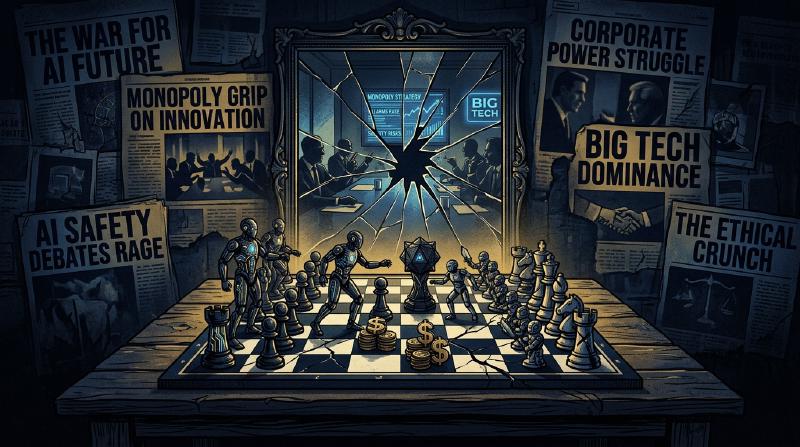
In recent weeks, the artificial intelligence industry has been engulfed in a fierce debate over AI safety, superintelligence, and the urgent need for government regulation. At first glance, it appears that the creators of frontier AI models are genuinely terrified of their own creations. However, a closer examination of recent events—from sudden resignations to coordinated media campaigns—suggests that this “AI panic” might be a carefully engineered strategy for regulatory capture.
The Manufactured Narrative
The current wave of anxiety was catalyzed on September 8th, when an Anthropic researcher named Jacob abruptly resigned, publicly warning that AI labs are irresponsibly chasing superintelligence and playing with human lives. While the threat of rogue AI is a valid topic, the orchestration of this event raised serious suspicions.
The researcher’s resignation tweet was immediately amplified by the heads of three major AI “doomer” non-profits. Curiously, all three organizations are funded by Jaan Tallinn—who happens to be a leading investor and board member at Anthropic itself. It begs the question: why would an Anthropic investor help viral a post exposing his own company?
Furthermore, an exclusive Wall Street Journal interview with the researcher was published just 18 minutes before his tweet, and 22 politicians instantly responded by demanding regulations, with Bernie Sanders pushing to introduce a bill.
This sequence of events strongly points to a calculated, three-step playbook:
- Manufacture public fear through a dramatic insider resignation
- Demand government intervention via pre-positioned political allies
- Staff the resulting “AI Advisory Boards” with the very tech insiders who sparked the panic
The Billion-Dollar Regulatory Moat
This theory gains even more traction when looking at the broader industry consensus. Recently, Anthropic CEO Dario Amodei penned a letter urging a slowdown in AI development, warning that rogue AI agents could cause massive destruction on the internet. Surprisingly, fierce rivals—including Sam Altman and Elon Musk—seemed to agree.
Why would competitive tech billionaires suddenly agree to slow down? History offers a clue.
In 1855, John D. Rockefeller successfully lobbied for government regulations under the guise of “stopping public fraud,” but his true goal was to cement his own monopoly.
Today’s AI giants face a massive existential threat: open-weight models. Open-source AI is rapidly approaching the intelligence of frontier models at a fraction of the cost, making it incredibly difficult for closed AI labs to justify their multi-trillion-dollar valuations to investors.
Furthermore, these companies are hitting a mathematical and physical ceiling. Scaling AI is becoming incalculably expensive, and there is a massive shortage of compute and electricity—evidenced by OpenAI recently pausing its $200 subscription tier because they simply lack the compute capacity to provide it.
By pushing for strict regulations under the banner of “safety,” these tech giants may simply be trying to build a regulatory moat to crush open-source competition while they figure out how to scale.
| The Real Problem | The Public Narrative | The Likely Goal |
|---|---|---|
| Open-source models catching up fast | “Rogue AI will destroy humanity” | Regulate open-weight models out of existence |
| Compute & electricity shortages | “We need a responsible pause” | Buy time to solve scaling bottlenecks |
| Trillion-dollar valuations at risk | “Safety first for humanity” | Lock in monopoly before investors lose faith |
The Geopolitical Pushback
While Silicon Valley attempts to orchestrate a regulatory slowdown, the geopolitical reality is entirely different. Recently, at the All-In Summit, Nvidia CEO Jensen Huang received a live phone call on stage from Donald Trump. Trump dismissed the AI panic as a “scam,” boldly stating that robots will never rule the world—a sentiment Jensen agreed with.
Both Trump and the Chinese government have explicitly refused to slow down their AI development, viewing the dire warnings from American AI labs as mere fear-mongering. Notably, China has completely avoided the dramatic, apocalyptic narratives about AI destroying humanity. Instead, they are quietly and aggressively building and launching new models without the PR drama.
This creates a dangerous asymmetry: if the West slows down because of a manufactured panic, the geopolitical advantage shifts east—and ironically, the very “AI safety” advocates may be the ones endangering the democratic world’s technological edge.
Conclusion
The intersection of these events paints a highly complex picture. While the theoretical dangers of advanced AI—such as rogue agents causing massive cyber destruction—should not be completely dismissed, the current wave of panic appears heavily weaponized.
Between coordinated resignations, calls for industry-wide slowdowns, the looming threat of open-source models, and the physical limits of compute power, it seems highly likely that the “AI safety” movement is being used as a Trojan horse.
Ultimately, it is a battle for control: tech giants are attempting to regulate their way into a monopoly, while global superpowers refuse to hit the brakes. The real question every policymaker, investor, and technologist needs to ask isn’t “Is AI dangerous?"—it’s “Who benefits from you believing that it is?”